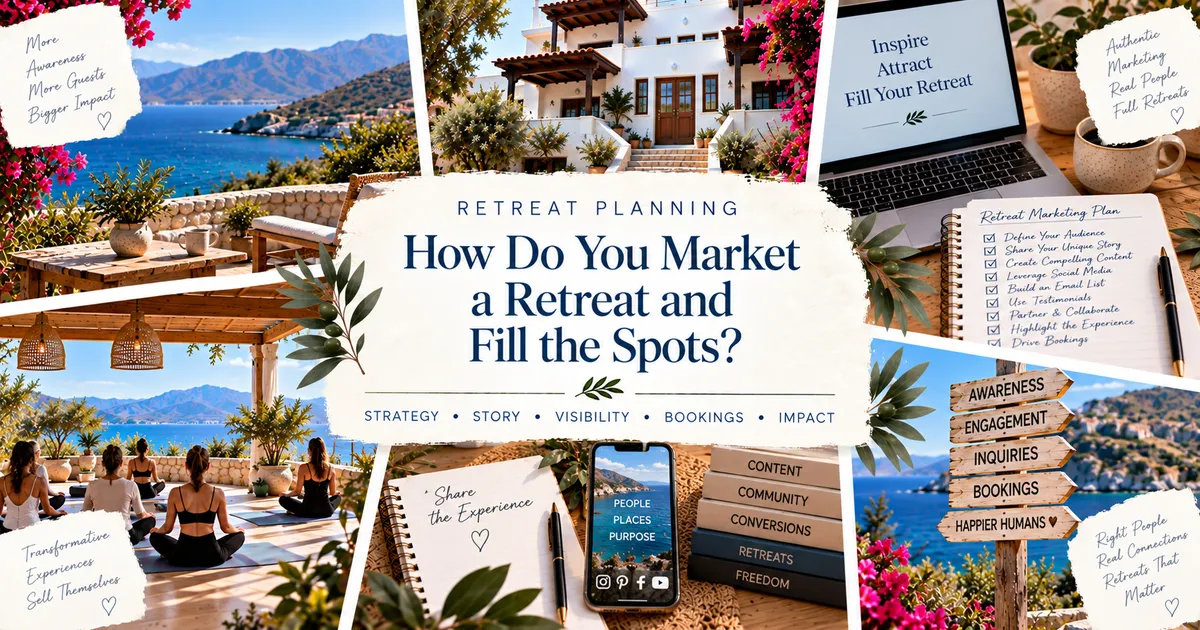
How Do You Market a Retreat and Fill the Spots?
The most effective way to market a retreat is usually not to reach the largest possible audience.
It is to reach the right people with an experience they already have a reason to want, then give them enough information and trust to make a relatively big decision.
For most retreat hosts, that means starting with existing relationships, using direct personal outreach and email, communicating the value of the experience clearly, and making the booking process easy.
Current 2026 retreat-marketing guidance consistently points toward warm audiences and one-to-one outreach as the strongest channels for retreat sales, ahead of relying primarily on organic social media or paid advertising.
Start With the People Most Likely to Say Yes
Before trying to attract strangers, look at the people who already know your work.
That might include:
Current or former clients
Newsletter subscribers
Members of your community
Students
Workshop attendees
People who regularly engage with your content
Past event attendees
People who have previously asked about working with you more deeply
A retreat is usually a significant purchase.
Guests may be committing several days of their time, travel expenses and thousands of dollars.
Trust matters.
Someone who has already experienced your coaching, teaching, facilitation or community has much less uncertainty to overcome than a stranger who discovered you yesterday.
That is why existing relationships are often the most valuable marketing asset a first-time retreat host has.
Sell the Reason to Come, Not the Schedule
A list of activities is not a marketing message.
“Breakfast at 8, workshop at 10, hiking at 2” tells someone what happens during the retreat.
It does not tell them why they should spend the money or get on a plane.
Your marketing should make the retreat's promise clear.
What will people gain from being there?
Maybe it is space to think.
Maybe it is progress on something they have been struggling with.
Maybe it is connection with a community they normally only see online.
Maybe it is rest, perspective, confidence, creativity or a meaningful personal change.
The destination, accommodations and activities help people picture the experience, but they should support that core reason for attending.
Current retreat sales guidance emphasizes clear positioning and a specific guest promise because vague “transformational experience” language makes it harder for a prospective guest to know whether the retreat is actually for them.
Make It Obvious Who the Retreat Is For
Trying to make the retreat sound perfect for everyone usually makes it compelling to no one.
Be specific.
Instead of:
“A retreat for anyone ready for change.”
You might say:
“A four-day strategy retreat for established consultants who want to step away from client work long enough to redesign the next year of their business.”
Or:
“A week for yoga teachers who want time to reconnect with their own practice instead of always being the person leading it.”
Specificity helps the right person recognize themselves.
It also makes personal outreach much easier because you know exactly who should hear about the retreat.
Personal Outreach Is Marketing
Many retreat hosts are comfortable posting about their retreat publicly but uncomfortable directly inviting someone who would genuinely be a good fit.
That is backwards.
If you know someone who seems ideal for the experience, it is completely reasonable to contact them personally.
That does not mean pressuring them.
It might simply mean:
“I thought of you because of what you mentioned about wanting time to work on this. I am hosting a retreat in October that may be a fit. Want me to send you the details?”
That can be more effective than hoping they happen to see the fourth Instagram post you published about it.
Current 2026 retreat marketing research ranks direct personal outreach among the strongest-performing channels, particularly when the host already has a relevant audience or client base.
Use Email for More Than One Announcement
One email saying “I am hosting a retreat” is not a marketing campaign.
People need different pieces of information before they are ready to buy.
Over time, your emails can talk about:
Why you created the retreat
Who it is designed for
What guests will get from it
The destination
The venue
A specific part of the experience
Common concerns
Pricing and payment plans
Travel logistics
Who has already joined
Remaining availability
Different people become interested for different reasons.
Someone may barely notice the first announcement but respond strongly when you explain the actual problem the retreat is designed to help them solve.
That is not annoying repetition when the communication is useful.
It is helping people understand the offer.
Use Social Media to Build Familiarity, Not as Your Entire Sales Strategy
Social media is useful.
It can show the venue, introduce the retreat concept, share behind-the-scenes planning, answer questions and let people imagine themselves there.
But posting repeatedly and waiting for registrations is not a reliable sales system.
Organic reach is unpredictable, and a person can be genuinely interested without seeing most of what you publish.
Current guidance still includes social content as part of retreat marketing, but consistently pairs it with email, direct outreach, partnerships and clear sales infrastructure rather than treating social media as the main engine.
Use social media to create awareness and trust.
Then give interested people somewhere clear to go next.
Your Sales Page Should Answer the Questions That Stop People From Booking
When someone becomes interested, do not make them hunt through Instagram posts and message you for basic information.
Your retreat page should clearly explain:
Who it is for
What the retreat is about
What guests will experience
Dates and destination
Accommodation
What is included
What is not included
Price
Payment options
Cancellation terms
How to get there
How to reserve a spot
Retreats already require a larger decision than buying a typical online product.
Confusion adds unnecessary friction.
Current 2026 booking guidance specifically identifies unclear pricing, complicated payment processes and incomplete information as reasons interested guests fail to complete a reservation.
Make It Easy to Pay
Once someone decides they want to attend, the buying process should be simple.
Do not create unnecessary hurdles.
Make the deposit amount clear.
Explain payment plans.
Tell them when later payments are due.
Show the cancellation terms before they pay.
Then give them an obvious way to reserve their place.
Payment plans can be particularly helpful for destination retreats because the purchase may be significant even for someone who can comfortably afford the experience overall.
Reducing payment friction is different from discounting.
You can make the purchase easier without making the retreat cheaper.
Address the Real Reasons People Hesitate
Someone who wants to attend may still have practical concerns.
They may be wondering:
“Can I afford this?”
“Can I take that much time away?”
“Will I know anyone?”
“Is it weird to come alone?”
“How difficult is the travel?”
“Am I experienced enough?”
“Will I have any downtime?”
“What happens if I need to cancel?”
Good retreat marketing does not pretend those concerns do not exist.
Answer them.
Frequently asked questions, emails, live conversations and individual follow-up all give you opportunities to reduce uncertainty.
Often the difference between an interested person and a registered guest is not more persuasion.
It is one unanswered question.
Give People Something Real to Picture
Retreats are experiential.
Show people the experience.
Use good images of the property and destination.
Explain what mornings might feel like.
Talk about the type of conversations you want to create.
Describe where people gather.
Share why you selected a particular experience.
If you have hosted previous retreats, testimonials and photographs can make the experience more tangible.
If this is your first one, you can still use property imagery, destination content and your existing credibility as a coach, teacher or facilitator.
Current 2026 retreat marketing advice also emphasizes showing the planning process and being specific about the experience rather than relying only on broad promotional claims.
Track Where Your Registrations Actually Come From
You may think Instagram is filling the retreat because that is where you spend the most time promoting it.
Then you ask the guests and discover that six of them booked because you emailed them personally.
Track the source.
At minimum, know whether each registration came from:
Personal outreach
Email
Social media
Referral
Podcast or content
Partnership
Paid advertising
Another source
This helps you spend more time on what actually produces registrations.
It also gives you much better information when you host your next retreat.
Do Not Expect Paid Advertising to Fix a Weak Offer
Paid ads can help some retreat hosts reach more people.
But buying traffic does not fix unclear positioning, weak demand or a confusing sales process.
Current 2026 retreat advertising guidance recommends using paid promotion to amplify an offer that already has evidence of converting rather than treating advertising as a last-minute rescue strategy.
For a first retreat, particularly if you already have a relevant community, your money and attention may be better spent on the audience you already have.
If you eventually discover that your offer converts well and you want more reach, advertising becomes a much more useful tool.
You Do Not Need Everyone. You Need the Right Number of People.
One of the psychological traps in retreat marketing is thinking the entire internet needs to care.
It does not.
If your target is ten guests, you need ten appropriate people to say yes.
That is a very different problem from trying to “go viral.”
Know your minimum viable enrollment.
Know your target number.
Then build your marketing around reaching enough qualified people to get there.
A retreat with ten perfect-fit guests can be much more successful than one with twenty people who joined because the host discounted the last available spaces and hoped for the best.
Filling a Retreat Is Mostly About Trust, Clarity and Consistent Follow-Up
People need to understand what the retreat is.
They need to recognize that it is for them.
They need to trust the person leading it.
They need to understand the price and logistics.
And they need enough time to make the decision.
That is why the most effective retreat marketing often looks less like a giant promotional campaign and more like clear communication repeated consistently across personal outreach, email, useful content and social proof.
You are not trying to convince everyone.
You are helping the right people confidently decide whether they want to come.
Planning and Selling Your Retreat?
The Ridiculously You Retreat Planning Guide walks you through defining your audience, shaping the retreat promise, building the sales message, presenting the destination, creating purchase clarity and tracking where your registrations come from.