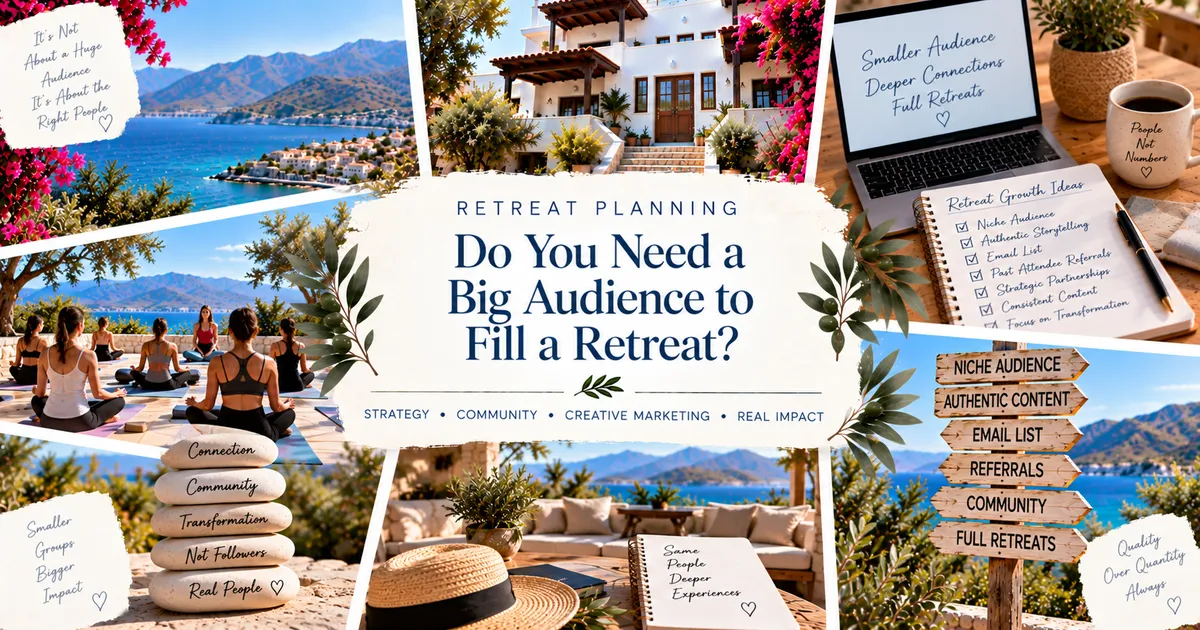
Do You Need a Big Audience to Fill a Retreat?
No. You do not need tens of thousands of followers to fill a retreat.
You need enough of the right people who trust you, want the experience you are offering, and are able to make the commitment.
That is a very different thing.
A retreat with ten available spots does not require an internet-famous host. In fact, a small, engaged audience can be significantly more valuable than a huge following made up mostly of people who will never buy from you.
So the question is not really:
"Do I have enough followers?"
It is:
"Do I have enough real demand for this specific retreat?"
A Following and an Audience Are Not the Same Thing
Imagine two retreat hosts.
One has 50,000 social media followers, but most of them casually consume free content and have never purchased anything.
The other has 1,500 followers, a small email list, and a group of past clients who regularly attend workshops, respond to emails, and invest in their services.
Which one has the better chance of filling a ten-person retreat?
You cannot answer from follower count alone.
The second host may actually be in a much stronger position because the relationship is deeper.
Retreats are high-trust purchases.
People are not simply buying a ticket.
They may be committing several days of their life, significant money, travel, and sometimes an international flight to spend time with you.
A smaller number of people who genuinely trust your work can matter much more than a huge number who barely know you.
Start With How Many Guests You Actually Need
The internet makes audience size feel like a vanity contest.
Your retreat does not care how many followers you have.
It cares whether you can fill the number of spots required for the retreat to work.
If your retreat has ten spots and your minimum viable enrollment is eight, your actual problem is:
Can I find eight right-fit people who are willing and able to buy this experience?
That is much more useful than asking whether you need 5,000 or 10,000 Instagram followers.
This is also why smaller retreats can be an advantage for a first-time host.
You are not trying to sell 500 tickets.
You may only need eight, ten, or twelve people.
Look for Evidence of Trust
Before hosting a retreat, ask yourself what your audience already does.
Do people:
Attend your workshops?
Buy your programs?
Hire you?
Join your community?
Reply to your emails?
Ask when they can work with you in person?
Travel to other events you host?
Refer other people to you?
Regularly engage in meaningful conversations with you?
Those are much more useful signals than a follower number.
If people already invest time and money with you, inviting them into a deeper in-person experience is a logical next step.
If almost nobody has ever bought anything from you, responded to an offer, or attended an event, a retreat may still be possible, but you have more uncertainty to resolve before taking on a major financial commitment.
"That Sounds Amazing" Is Not Demand
This is one of the most important distinctions for first-time retreat hosts.
You mention the idea.
People say:
"Oh my God, that sounds amazing!"
That feels encouraging.
It is encouraging.
But it is not the same thing as someone actually attending.
People can genuinely love an idea and still not be willing to spend $2,500, get on a plane, and take four days away from their normal life.
So before interpreting enthusiasm as proof that the retreat will fill, ask more specific questions.
Would they realistically travel for this?
What dates work?
What price range feels realistic?
What would make the retreat compelling enough for them to attend?
What would stop them from coming?
The more specific the question becomes, the more useful the answer becomes.
Validate the Idea Before You Take on Major Risk
You do not have to book an expensive property first and then discover whether anybody wants to come.
There are progressively stronger ways to test demand.
Start with conversations.
Talk directly with the kinds of people you hope will attend.
Then you might create an interest list or waitlist.
Now someone has taken a small action beyond simply saying the idea sounds nice.
The strongest evidence comes when people are willing to make an actual financial commitment.
A useful progression looks like this:
Conversation or survey
Interest list or waitlist
Serious inquiry
Purchase or deposit
The closer someone gets to actually committing money, the stronger the evidence that the demand is real.
That does not mean you should irresponsibly sell a retreat that does not exist.
If you accept deposits before every detail or venue is final, be completely transparent about what is confirmed, what is still pending, whether the payment is refundable, and what happens if the retreat does not move forward.
The point is to reduce risk, not move it onto your guests.
Your Warm Audience Matters More Than Your Total Audience
Think about the people closest to your work first.
Your first retreat guests may come from:
Current clients
Former clients
Email subscribers
Students
Community members
Past event attendees
Referral partners
People who have repeatedly expressed interest in working with you more deeply
These are the people who already understand what you do.
That makes them very different from someone who happens to follow you because one social media post appeared in their feed six months ago.
Retreats require substantially more trust than lower-priced products, which is why direct relationships matter so much.
A Small Audience Can Still Be the Wrong Audience
There is an important caveat.
"Small audiences can fill retreats" does not mean any small audience can fill any retreat.
The retreat still has to fit them.
If your audience primarily buys $29 digital products, you cannot automatically assume they will purchase a $5,000 international retreat.
If your community consists mostly of parents with young children, a ten-day trip with little notice may be difficult regardless of how much they like you.
If your followers came for business advice and you suddenly launch an unrelated spiritual retreat, trust in you does not necessarily equal demand for that offer.
Ask whether the people you already reach are aligned with:
The purpose
The destination
The price
The amount of time required
The experience itself
Audience fit matters as much as audience size.
Do Not Use Followers as an Excuse to Wait Forever
It is easy to create an arbitrary milestone:
"I will host a retreat once I have 10,000 followers."
Why 10,000?
Why not 7,000?
Why not 1,200?
The number feels safe because it delays the decision.
But a larger following does not automatically create more buyers.
You could spend two years increasing your audience while never learning whether the people already there want the retreat.
Testing the idea gives you better information than waiting for a vanity metric.
What If the Response Is Weak?
That is useful information too.
If you talk to your audience and very few people show meaningful interest, do not immediately conclude:
"I can never host a retreat."
Look at what the response is telling you.
Maybe:
The destination is wrong
The price feels too high
The dates do not work
The retreat promise is vague
The experience is too long
Your audience needs more notice
You are speaking to the wrong group
People like the idea but not enough to prioritize it
Those are solvable problems.
It is much better to discover them before putting down a large nonrefundable venue deposit.
You Need Demand, Not Fame
A successful retreat does not require everyone to know who you are.
It requires enough of the right people to believe:
This is for me.
I trust this person.
I want this experience.
It is worth the time and money.
I am ready to go.
That is why a small audience can absolutely fill a retreat.
Do not measure readiness by followers alone.
Know how many guests you actually need.
Look at the strength of the relationships you already have.
Test the concept.
Ask for meaningful expressions of interest.
And wherever practical, get stronger evidence of demand before taking on major financial commitments.
You do not need a massive audience.
You need a retreat that the audience you already have genuinely wants.
Thinking About Hosting Your First Retreat?
The Ridiculously You Retreat Planning Guide walks you through defining your audience, evaluating real demand, calculating your minimum viable enrollment, choosing a destination, building the financial model, and turning the retreat idea into an actual plan.